Infrastructure Management
Easily deploy, manage, and maintain all components of your blockchain infrastructure.
Application Development
Build, deploy, and distribute applications efficiently across network environments.
Tooling & Support
Accelerate development with integrated tooling and expert support.
Trusted by leading financial institutions.

Canton Network
Catalyx enables organizations of any size to seamlessly connect and onboard to the Canton Network.Catalyx enables organizations of any size to seamlessly spin up their validator nodes, connect their infrastructure, and onboard to the Canton Network.
Once the infrastructure is operational and connected, organizations can perform all necessary operations through the Catalyx platform to participate in the Canton Network.
Once active across the network, Catalyx supports organizations to build, deploy, and distribute their own complex, scalable, production-grade applications.
100+
Active validators served
10+
Canton applications in production
7+
Years of DAML & Canton Expertise
We are part of
Founding member of Canton Foundation. Super Validator & SV Operator.
Catalyx Products & Solutions
One product suite covering every layer of blockchain operations, so your team stays on the business

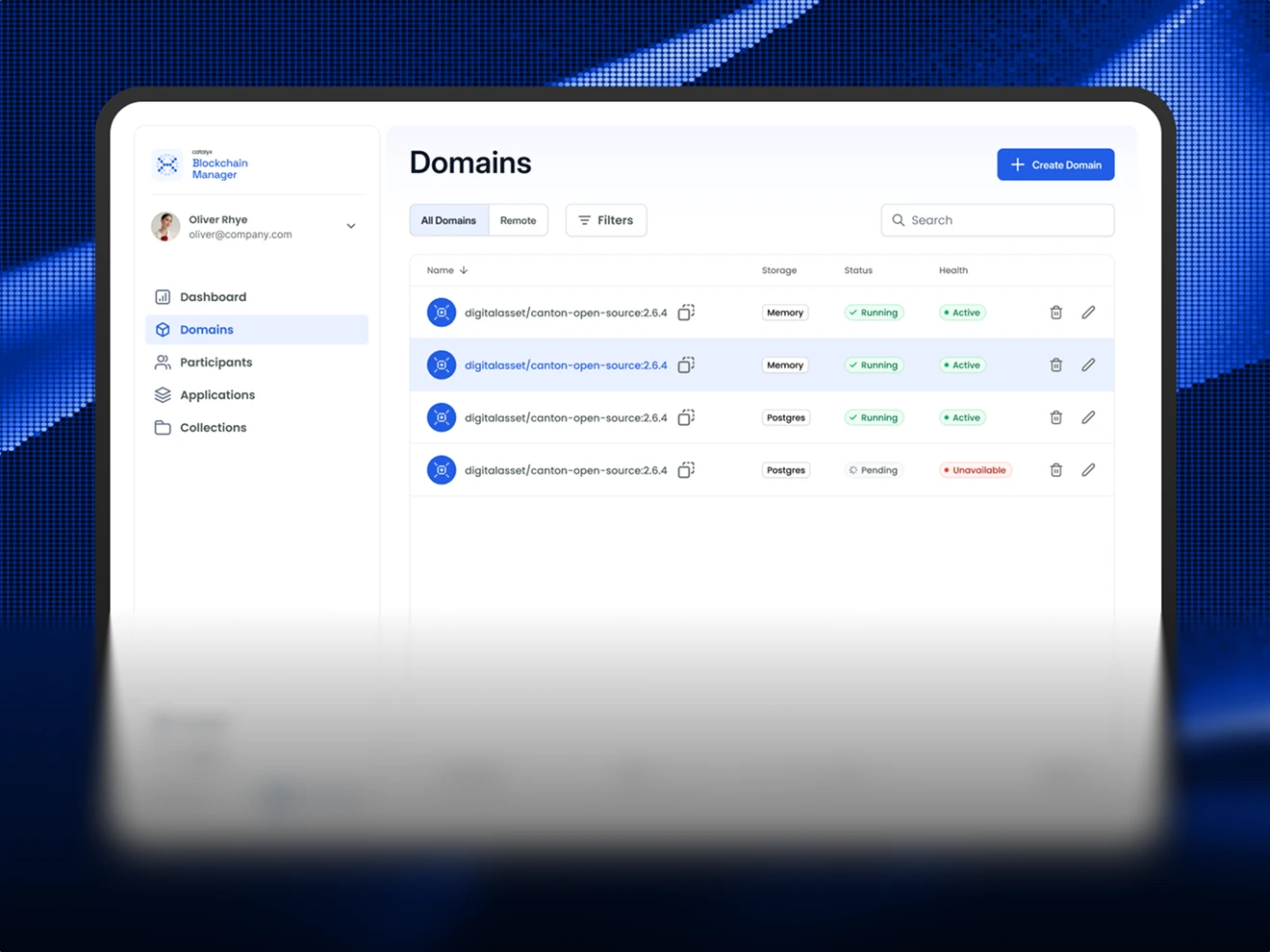
CatalyX Blockchain Manager is the leading infrastructure management platform on the Canton Network, enabling organizations of any size to easily deploy and operate their infrastructure.
Deploy Blockchain Manager with full control as a self-service platform or as a fully managed solution by the CatalyX team.



CatalyX DAML Agent is an AI-assisted development tool that helps teams write, understand, and refine DAML smart contracts, powered by over 7 years of IntellectEU's hands-on experience.

CatalyX Wallet Manager is an enterprise treasury and wallet management platform for monitoring crypto liquidity, tracking obligations, and planning funding.
Supported Protocols
The infrastructure layer for institutional blockchain



Canton is the leading
institutional blockchain network.
In processed RWAs
In average daily repo volume
Active validators
Largest global investment banks are
actively participating

Reach out to discuss all things Canton

April 9, 2026•6 min read
Like most public blockchain networks, the Canton Network charges a fee for its use. Canton users pay two types of fees to use the Global Synchronizer (i.e. network): synchronizer traffic fees and holding fees.
Unlike most others, the synchronizer traffic fee is fixed at a certain amount of USD per MB of bandwidth or "synchronizer traffic". Although fees are quoted in USD, they are paid using the network's native utility coin: Canton Coin (CC). Currently, the price for 1MB of traffic on the Canton Network is $60 USD.
Besides the "synchronizer traffic fee", the Canton Network also charges a "holding fee". A holding fee is a fixed cost associated with maintaining an active Canton Coin record (UTXO) on the ledger.
Fee parameters, traffic pricing, limits, and related tokenomics settings are subject to change via a 2/3 majority of Super Validators and the Canton Improvement Proposal (CIP) process.
Global Synchronizer Traffic Fees represent the cost of consuming synchronization capacity or "bandwidth" on the Canton Network.
Traffic refers to all messages from participants that must be sequenced on the network.
Most prominently, traffic is consumed by Daml workflows as part of the Canton transaction processing protocol, including confirmation requests (sent when a participant initiates a transaction) and confirmation responses (sent by participants who host stakeholders of a transaction). Not only custom Daml workflows count towards traffic spend - automated "built-in" workflows such as rewards collection also use traffic.
In addition to Daml workflow messages, participants also use traffic for submitting topology transactions (for example, allocating new parties or vetting newly uploaded DAR packages) and exchanging periodic ACS commitments to ensure synchronisation.
Importantly, traffic accounting is "by participant": all parties hosted on the same participant share the same traffic balance.
Every participant receives a limited amount of synchronizer traffic free of charge via a base-rate allowance. The base rate is defined as a burst amount over a time window, so that even when fully depleted, the available base-rate traffic balance recovers fully after a "window"-long period of inactivity.
Usage beyond this allowance consumes paid traffic (also called "extra traffic"), which is charged by burning Canton Coin. The base rate traffic balance is always consumed first; extra traffic is only drawn down when the base rate is fully depleted. When neither base rate nor extra traffic balance is available, the sequencer will deny further submission attempts until either the base rate recovers or extra traffic is topped up.
The current synchronizer traffic parameters are recorded in the global AmuletRules contract and can be retrieved via the Scan API using the /api/scan/v0/amulet-rules endpoint.
For example, this returns a JSON object containing:
{
"baseRateTrafficLimits": {
"burstAmount": "400000",
"burstWindow": { "microseconds": "1200000000" }
},
"extraTrafficPrice": "60.0",
"readVsWriteScalingFactor": "4",
"minTopupAmount": "200000"
}
To explain these fields:
To "buy" traffic, Canton Coin is burned by the participant and converted into extra traffic balance. On-ledger MemberTraffic contracts track each validator's traffic state and are updated atomically whenever CC is spent for buying traffic. SVs then update the in-sequencer traffic state based on the MemberTraffic state they observe on the ledger, ensuring paid traffic fees are translated into actual traffic balance increases.
The validator app contains built-in top-up automation that automatically buys traffic to meet pre-configured throughput needs. Operators configure a target throughput (bytes per second) and a minimum top-up interval (seconds). Note that traffic is non-transferable - traffic balances cannot be converted back to Canton Coin.
Canton Coin employs a burn-mint equilibrium mechanism. Instead of paying fees directly to network infrastructure providers, all fees for using Canton Coin and for creating a traffic balance on the Global Synchronizer are burned by the user who submits the transaction. In return for operating applications and network infrastructure, providers can mint new Canton Coins. Thus, the usage fee from the user to the provider is indirect via the burn-and-mint mechanism.
This creates a self-correcting price mechanism: as more participants use the network and burn CC for traffic, supply decreases, which tends to increase the CC/USD rate, which in turn decreases the number of CC needed per MB - and vice versa. You can read more about this in the Canton Coin Whitepaper.
A holding fee is a fixed cost associated with maintaining an active Canton Coin record (UTXO) on the ledger. It is computed per round but not charged continuously to active participants.
Following CIP-0078, holding fees no longer apply to Canton Coin transfers. Instead, they accrue notionally over time and are only enforced if Super Validators explicitly expire a coin whose accrued holding fees meet or exceed its coin amount. When a coin is expired, the entire coin amount is charged as holding fees, the coin amount is burned, and the coin contract is archived.
This mechanism exists to limit the lifetime of long-lived, low-value ("dust") coin contracts and to bound ledger growth. It does not affect actively used coins or normal transaction flows.
One of the most significant recent developments in Canton Network tokenomics is CIP-0104: Traffic-Based App Rewards, approved on February 12, 2026.
CIP-0104 proposes to improve the quality of app reward incentives by removing featured app markers and instead basing an app's rewards on the actual traffic spent on transactions that change the state managed by the app. This is achieved by measuring traffic spent directly on the Global Synchronizer using sequencer and mediator data.
In the post-CIP-0104 model, application rewards are derived directly from the actual Global Synchronizer traffic spent on successful confirmation requests involving a featured application. This transition replaces governance-defined marker issuance with a protocol-measured, traffic-weighted model, ensuring rewards are directly aligned with measurable economic activity on the network.
In practical terms: the more meaningful traffic your application drives on the network, the more Canton Coin your application can earn back through minting - creating a direct and transparent link between usage and reward.
This CIP also proposes to make protocol-conformant confirmation responses free, so that validator nodes only pay for the submission of transactions by their users - an action validators can explicitly gate and charge for if required. This enables validator operators to manage traffic costs and fosters decentralization of apps and wallets.
The Canton Network fee structure has been revised through the CIP governance process. Changes require approval by a 2/3 supermajority of Super Validators and apply only to future activity.
| CIP | Topic | Approved |
|---|---|---|
| CIP-0002 | Establishes the ~$1 per typical transfer economic target for Global Synchronizer usage | 2024-01-26 |
| CIP-0042 | Formalizes the target-based $/MB pricing model - price may be adjusted to preserve the $1 target | 2024-12-14 |
| CIP-0078 | Removes Canton Coin transfer fees; confirms traffic fees + holding fee expiry as the only ongoing protocol-level costs | 2025-09-15 |
| CIP-0084 | Introduces the Tokenomics Committee recommendation process for traffic pricing adjustments | 2025-10-17 |
| CIP-0104 | Traffic-Based App Rewards - rewards now derived from actual Global Synchronizer traffic, not governance markers | 2026-02-12 |
Understanding the fee model is useful. Managing traffic balances, automating top-ups, and monitoring validator health across production deployments is a different challenge.
CatalyX Blockchain Manager, built by IntellectEU as a founding member of the Canton Foundation, provides the infrastructure management layer for Canton validator operators - from node deployment to operational tooling. Whether you're running a single validator node or managing fleet-scale infrastructure, the platform handles the operational overhead so your team focuses on building.
Interested in Canton Network participation? Explore CatalyX Blockchain Manager and reach out to the IntellectEU team to discuss your setup.

March 23, 2026•6 min read
The maturity of the Canton Network ecosystem requires a parallel evolution in the tools used to manage it. As institutional adoption of blockchain moves from pilot programs to production-grade infrastructure, the bar for stability, security, and developer experience has risen.
To meet these demands, we are introducing CatalyX: a unified product suite designed to streamline how enterprises deploy, manage, and scale on blockchains like Canton Network.
More than a visual update, CatalyX represents a consolidation of our core blockchain technologies into a single, cohesive offering. While the look and feel have evolved to reflect the scale and maturity of modern Canton deployments, our mission remains the same: making institutional blockchain operations and application development enterprise-ready.
The suite integrates the essential pillars of blockchain management and development into a streamlined workflow.
Formerly known as Catalyst Blockchain Manager

The Blockchain Manager remains the foundation for blockchain infrastructure. It provides a centralized management console that simplifies the complexities of blockchain orchestration.

Formerly known as Catalyst Package Manager

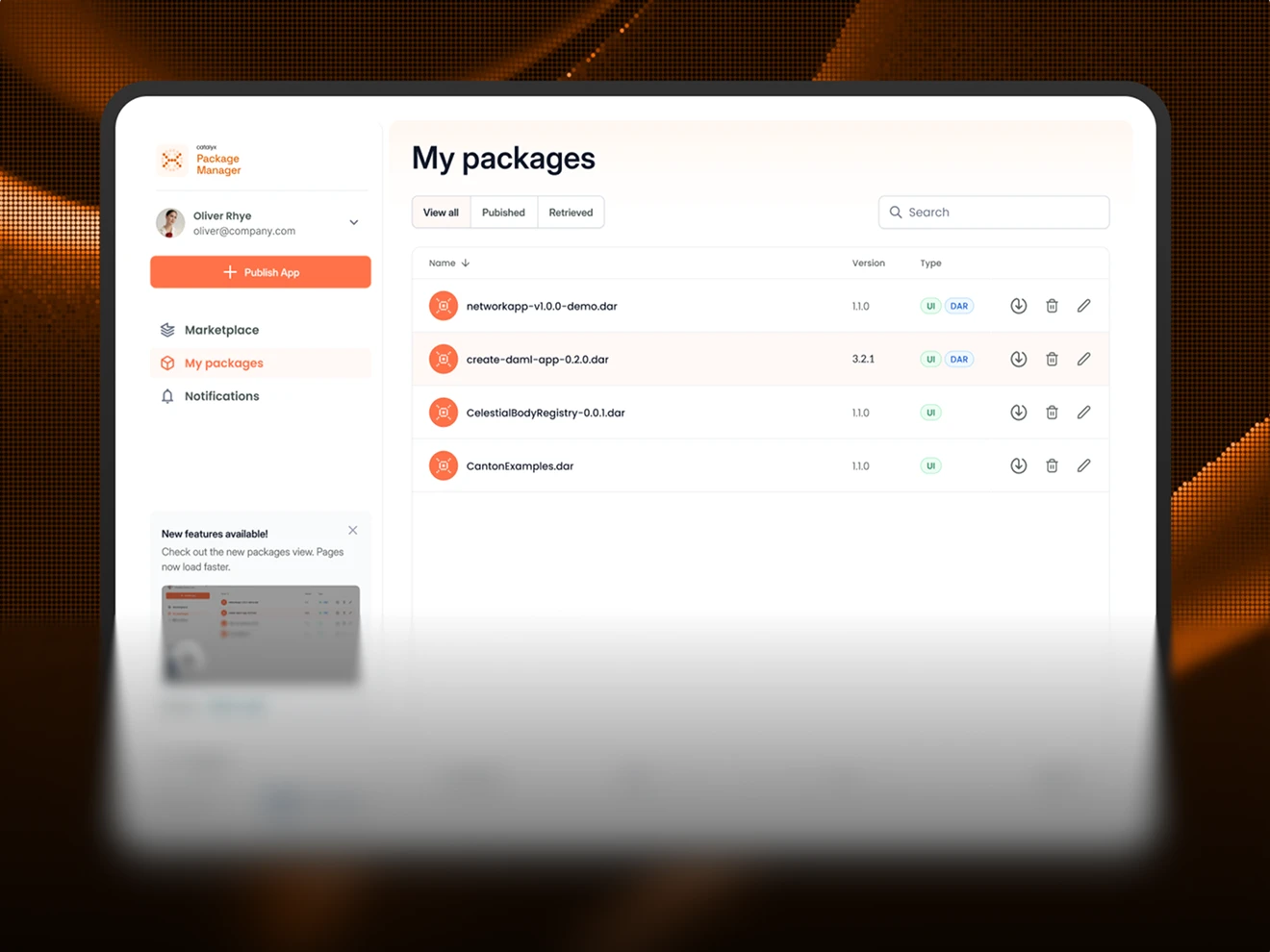
Managing daml models and application code requires the same level of rigor as traditional software development. The Package Manager provides a secure bridge between development and production.

Rounding out the suite are our upcoming components: the DAML Agent and CatalyX Wallet. These adjacent tools are designed to facilitate building sophisticated decentralized applications.

The transition to CatalyX is driven by the need for a visual and UX system that consolidates our capabilities and offers greater clarity. We want to maximize our capacity to help companies deliver on their business needs and speed up use cases development, rather than spending their time overcoming technical challenges. As our customers move from managing single nodes to complex, multi-party networks, they require a unified interface that reduces cognitive load and improves operational efficiency.
The new CatalyX identity reflects a professional, institutional-grade toolkit that grows alongside your network participation.
While the products provide the automation, our team provides the strategy. CatalyX is backed by the deep domain expertise of IntellectEU:
Our engineers are available to support custom developments, unique integration requests, and complex migration paths, ensuring that your technical stack remains optimized for your specific business goals.
Current users of the CatalyX suite will experience no disruption to their existing deployments. The transition is focused on the interface and brand identity: the underlying technology remains as stable as ever. Our roadmap includes:
Whether you are deploying your first validator or scaling a global network, CatalyX provides the tooling necessary for institutional success.

March 23, 2026•6 min read
Most financial institutions enter the digital asset space looking for yield. They see "staking" as a fixed-income proxy way to earn 4-5% APY on held assets. But this "yield trap" obscures the real operational requirement of enterprise blockchain: settlement.
When a bank issues a digital bond or a payment processor settles a cross-border transaction, they aren't "voting" on network consensus. They are writing critical financial data to a shared ledger. This requires a fundamental shift in infrastructure strategy from passive validator setups designed for rewards to active, high-availability blockchain node infrastructure designed for read/write performance.
Search volume data paints a clear picture: "staking as a service" dominates institutional inquiries. It looks and feels like a financial product. You deposit assets, you get a return. It fits neatly into existing asset management workflows.
However, operational utility is an IT function, not an asset management one. When an institution moves from holding tokens to using the network - for Repo settlement, intraday payments, or bond issuance - the infrastructure requirements change drastically.
A staking provider’s primary goal is to avoid slashing (penalties for downtime). If a staking node goes offline for ten minutes, you lose a few dollars in rewards. It’s an annoyance. Conversely, if an operational node responsible for a DVP (Delivery vs. Payment) settlement goes offline for ten minutes, a billion-dollar trade fails. The counterparty risk skyrockets. Regulatory reporting windows are missed.
Banks don't need a passive yield generator. They need a crypto infrastructure for banks that guarantees message delivery and settlement finality.
To understand the gap, we must distinguish between the two primary node types in enterprise networks like Canton.
For a tokenization use case, the Participant node is your lifeline. It connects your internal legacy systems (like a core banking platform) to the blockchain.
A platform like CatalyX Blockchain Manager handles both. It allows a bank to spin up a Validator for the trading desk to earn yield, while simultaneously deploying a high-availability Participant node cluster for the payments team. All managed within the same environment.
An operational node is useless if it stands alone. Its value comes from connectivity.
Unlike a staking node, which largely communicates peer-to-peer with other blockchain nodes, an operational node requires high-throughput API connections to internal bank systems. The challenge isn't just syncing the ledger; it's getting data out of the ledger and into a risk management dashboard in milliseconds.
This brings us to the concept of enterprise blockchain nodes designed for High Availability (HA) and Geo-Redundancy. If your primary data center in New York goes dark, your node infrastructure must failover to London automatically, without dropping the mempool or missing a settlement instruction. Standard staking providers rarely offer this level of intricate, application-layer failover because their business model relies on simple uptime for rewards, not complex transaction routing.
Security in settlement is distinct from security in custody.
Institutional crypto custody often relies on MPC (Multi-Party Computation) wallets. These are excellent for human-approved transfers, where a quorum of officers must sign off on a transaction. Ideally, this process is slow and deliberate.
Operational nodes, however, need to sign transactions programmatically, often thousands of times per hour. You cannot have a human approving every automated market maker trade or dividend payout.
This requires deep integration with Hardware Security Modules (HSMs). Your blockchain node infrastructure must be able to access signing keys securely within an HSM environment (like AWS CloudHSM or Azure Key Vault) to sign transactions automatically, without the keys ever being exposed to the application layer.
The theoretical need for robust infrastructure became operational reality on November 18, 2025. Societe Generale-FORGE (SG-FORGE) completed its first digital bond issuance in the United States, a landmark event for institutional adoption.
The issuance didn't happen on a testnet. It settled on the Canton Network, utilizing Broadridge’s tokenization capabilities. The stakes were high: this was a live financial instrument, a short-term floating rate note purchased by DRW.
To ensure the settlement occurred instantly and securely, SG-FORGE and Broadridge didn't rely on generic staking setups. As detailed in the official announcement, they utilized CatalyX Blockchain Manager to operate their respective nodes on the Canton Network’s Global Synchronizer.
This choice highlights the critical nature of the "plumbing." SG-FORGE needed guaranteed delivery. They needed a platform that could deploy and manage Canton Network nodes with enterprise-grade reliability, ensuring that when the "issue" command was sent, the node executed it without latency or failure. Staking yield was irrelevant; operational finality was everything.
Source: Societe Generale Issues First Digital Bond in the US
The "crypto casino" phase of institutional adoption is fading. The next phase is about plumbing: building the rails that allow trillions of dollars in real-world assets to move on-chain.
Institutions must stop evaluating infrastructure vendors solely on APY or low fees. You get what you pay for. If your node goes down during a settlement window, the cost of that failure will dwarf any staking rewards earned that quarter.
Ensure your institution’s infrastructure is ready for settlement, not just speculation. Explore CatalyX Blockchain Manager for enterprise-grade node operations that prioritize business continuity.

January 14, 2026•6 min read
The early days of crypto infrastructure were defined by one metric: speed. "Move fast and break things" wasn't just a motto; it was the operational standard. Developers rented public RPC endpoints, spun up shared nodes, and built dApps on infrastructure that was effectively a black box.
That era is over.
As we move past the January 2025 deadline for full DORA compliance in the EU and face heightened Third-Party Risk Management (TPRM) enforcement from US regulators (OCC, Fed), the traditional "Nodes-as-a-Service" (NaaS) model faces an existential crisis.
For institutions moving trillions in value - not just speculative tokens - the issue isn't just about "sharing" resources. It is about control. Relying on a third-party provider to operate your critical infrastructure without deep visibility into security controls, data segregation, and failover logic is no longer just a technical shortcut. It is a compliance violation waiting to happen.
For years, Web3 infrastructure providers sold convenience. They promised that you could "click a button" and get an endpoint. This worked perfectly for retail experimentation and rapid prototyping. If an API went down for 30 minutes, it was annoying, but it wasn't a regulatory event.
We are now seeing a hard pivot from experimentation to production. We aren't talking about NFT drops anymore; we are talking about tokenized securities, intraday repo markets, and regulated stablecoins. When you move regulated assets, your infrastructure cannot be a rented commodity. It must be an auditable asset.
The "Wild West" relied on shared resources and "best-effort" uptime. That doesn't cut it when a 50ms delay in settlement can trigger a margin call or a failed trade.
The entry of giants like the DTCC and Societe Generale isn't just a press release; it's a signal that the underlying architecture is changing. These institutions don't just "buy crypto." They build settlement rails that must integrate with legacy banking cores.
This brings us to the regulatory hammer - or rather, two hammers:
If you are relying on a purely rented API, you have introduced a single point of failure that is opaque to your risk committee. Whether it's DORA in the EU or TPRM in the US, the message is the same: You cannot audit a node you do not control.
Learn more about the specific operational resilience requirements in the official DORA legal text or Third-Party Relationships: Risk Management

The pure NaaS model suffers from three fatal flaws when applied to Institutional DeFi:
We built CatalyX Blockchain Manager to solve the ownership paradox: institutions need the control of self-hosting but lack the desire to hire 50 DevOps engineers to manage it.
CatalyX isn't about renting a node. It is about orchestrating your own infrastructure.
We allow institutions to deploy blockchain nodes directly onto their own cloud environment - whether that's AWS, Azure, GCP, or a private cloud. You rely on our automation to handle the heavy lifting of Kubernetes configuration, updates, and patching, but the asset remains yours.
This is the shift from "Subscription" to "Orchestration." You own the compliance; we provide the technology to manage it efficiently.
The cost of "cheap" infrastructure today is technical debt and compliance fines tomorrow.
Building for 2030 means assuming that networks will fragment and reconnect. We see this with the rise of the Canton Network, which is purpose-built for privacy and interoperability in financial markets. Your infrastructure needs to be able to handle these complex, privacy-enabled networks without weeks of downtime for upgrades.
Investing in an abstraction layer like CatalyX is a strategic hedge. It allows you to adopt new protocols and standards without rebuilding your internal operations team from scratch. It bridges the gap between the agility of Web3 and the stability required by the boardroom.
The market has matured, and the tools must mature with it. The days of treating financial infrastructure like a Netflix subscription are over. For the Lead Technical Architect or the CTO at a Tier 1 bank, the priority is no longer just "access" - it is control, resilience, and compliance.
Don't just rent access to the blockchain. Take control of your infrastructure. Schedule a demo of CatalyX Blockchain Manager to see how we ensure regulations readiness and operational sovereignty.
Press Room
We are proud to have supported Société Générale in completing the first digital bond issuance in the United States on the Canton Network - providing the infrastructure layer that enables institutional-grade digital securities and real-time settlement

We partnered with Digital Asset on the Regulated Settlement Network (RSN) PoC, providing infrastructure through our CatalyX Blockchain Manager. The project explored 24/7 simultaneous settlement for multi-asset and cross-network transactions, including tokenized bank deposits and U.S. Treasury securities.
Hashnote introduced USYC, a tokenized money market fund with built-in privacy, on the Canton Network. Powered by CatalyX Blockchain Manager, the launch enabled seamless infrastructure management while leveraging Canton’s advanced privacy and composability features.
LayerZero Labs and IntellectEU are collaborating on a new approach to Delivery vs. Payment (DvP), combining on-chain settlement with off-chain payment rails. The proof of concept enables secure cross-chain transactions initiated through SWIFT MT messages and completed with smart contracts across private and public blockchains using LayerZero and CatalyX infrastructure.

At the Digital Euro Conference, we showcased CatalyX (previously known as “Catalyst”) with a live demonstration, highlighting how it streamlines digital asset management and enables efficient settlement orchestration across multiple DLT networks in regulated industries.

You can reach us anytime via: catalyst-product@intellecteu.com
By entering your email address you permit us to store and use your email for the purposes of marketing and communication with you.
All personal data is processed according to the IntellectEU Privacy Policy. You can withdraw your permission and require removal of your personal data any time by contacting us via email privacy@intellecteu.com or by pressing link Unsubscribe in any email received from us.